











Physicians in the United States spend up to 55% of their workday on EHR documentation and administrative tasks, leaving less time for direct patient care.
AI has emerged as a solution to streamline workflows. AI Clinical Notes Software reduces time spent on charting by automatically converting patient encounters into structured notes. Meanwhile, practices increasingly rely on Direct Primary Care Software (DPC Software), Remote Patient Monitoring, and Chronic Care Management Software to manage care beyond the office. Together, these tools allow physicians to focus on patients while maintaining operational efficiency.
The Current State of EHR Workflows in the U.S.
EHRs are essential, but most physicians report frustration with time-consuming documentation, complex navigation, and manual billing tasks. A recent HealthIT.gov report shows that 71% of U.S. hospitals now integrate predictive AI into EHRs, improving documentation and decision support, but leaving operational and longitudinal care workflows under-optimized.
Key Ways AI Is Transforming EHR Workflows
AI-Powered Clinical Documentation
AI Clinical Notes Software transcribes patient encounters in real time, generates structured notes, and can even pre-populate billing codes.
Physician perspective: Many report saving 5–10 minutes per visit, which adds up to hours weekly—enough time for additional patient care or administrative review.
Intelligent Clinical Decision Support
AI provides predictive analytics for risk stratification and preventive care. For example, a physician using AI can quickly identify high-risk diabetic patients for proactive outreach. Integrating Remote Patient Monitoring Software allows clinicians to track glucose trends between visits, enhancing chronic care management.
Automation in Coding and Billing Preparation
AI suggests CPT codes and highlights potential documentation gaps, reducing billing errors. When combined with Direct Primary Care Software, billing becomes streamlined for recurring visits and preventive care plans.
Smart Data Retrieval and Chart Navigation
AI structures unorganized EHR data, enabling quick retrieval of lab results, medication history, and prior notes. Coupled with Behavioral Health Management Software, physicians can track patient mental health trends over time without manual chart reviews.
The New Workflow Gap Created by AI-Driven EHRs
AI accelerates clinical documentation, but exposes slower administrative and patient follow-up workflows. Faster visit notes make scheduling and care coordination bottlenecks more apparent.
Tip for physicians: Implement DPC Software for scheduling flexibility, and combine it with Remote Patient Monitoring and Chronic Care Management Software to proactively manage patient outcomes between visits.
Extending AI Benefits beyond the EHR
To fully leverage AI:
- Direct Primary Care Software (DPC Software) streamlines visits and patient enrollment
- Remote Patient Monitoring Software tracks vitals and adherence
- Chronic Care Management Software coordinates ongoing treatment for conditions like diabetes and hypertension
- Behavioral Health Management Software ensures therapy follow-ups and mental health support
Physician tip: Choose platforms that integrate seamlessly with your EHR to avoid duplicate data entry and maximize workflow efficiency.
Where Advaa Fits into an AI-Enabled EHR Ecosystem
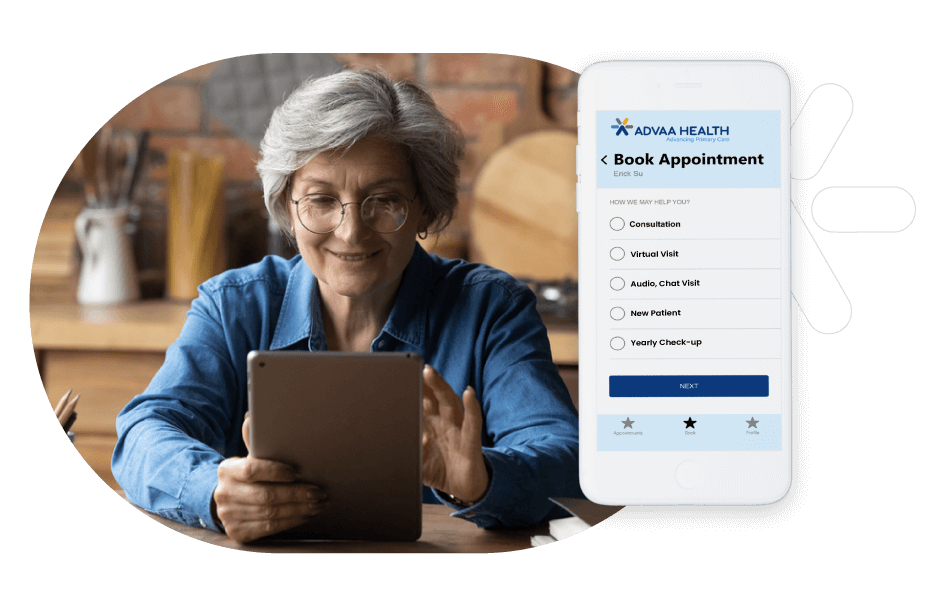
Advaa Health complements AI-enabled EHRs and works seamlessly alongside DPC, Remote Patient Monitoring, Chronic Care Management, and Behavioral Health Management:
- Automates scheduling and digital intake
- Enables real-time insurance verification
- Supports longitudinal care and chronic disease management
- Reduces administrative burden, allowing more time for patient care
What Physicians Should Look for in 2026
Checklist for adopting AI-enabled EHRs and complementary software:
- AI Clinical Notes Software: Efficient, real-time documentation
- Interoperability: Seamless integration with EHR and third-party tools
- DPC and Remote Patient Monitoring Software: Streamlined operational and longitudinal workflows
- Patient-Centric Design: Focused on both clinical efficiency and front-office operations
Implementation tip: Start with one module (e.g., Remote Patient Monitoring) and expand to others once workflows are standardized.
Conclusion: AI Works Best When Paired with Workflow Tools
AI in EHRs improves documentation, decision-making, and predictive insights, but operational and longitudinal workflows must also be addressed. By combining AI Clinical Notes Software with DPC Software, Remote Patient Monitoring Software, Chronic Care Management Software, and Behavioral Health Management Software, practices can achieve complete workflow optimization, improved patient outcomes, and reduced physician burnout.
Learn how a digital front office can complement your AI-enabled EHR workflow and enhance patient care.