














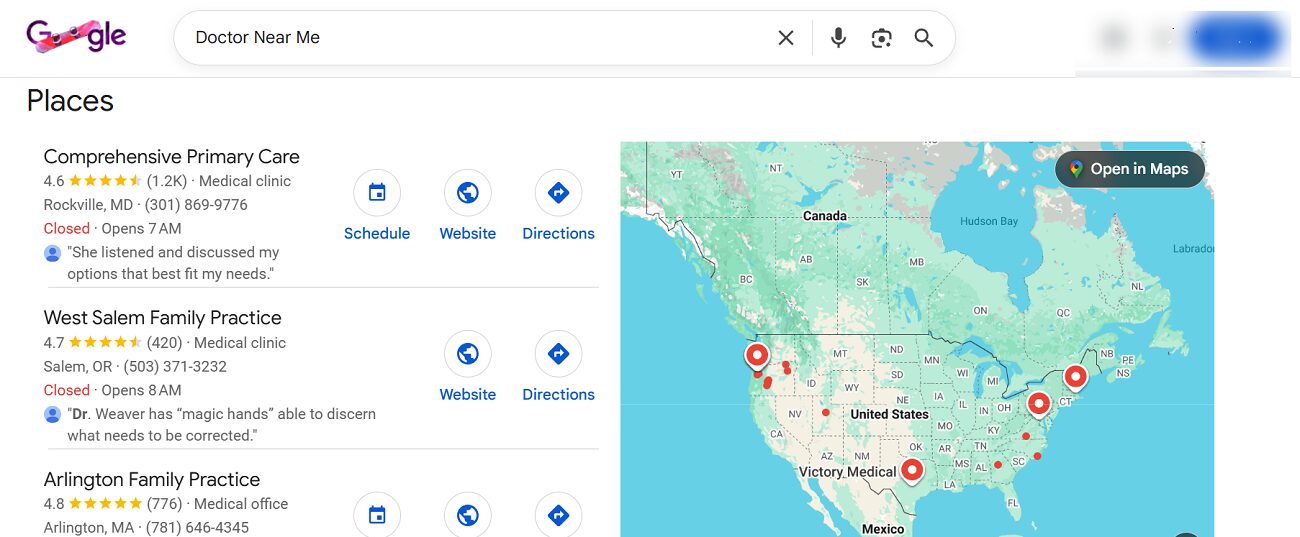


Most patients today don’t browse phone books or neighborhoods — they check their phones. When someone types “doctor near me,” “primary care physician near me,” or “family doctor in [city],” Google decides what gets seen first. But if your practice doesn’t show up in those local results, it’s not because your care is lacking — it’s because your local SEO signals might be.
In this article, we’ll break down why visibility fails and how to fix it — without fluff.
How “Doctor Near Me” Searches Actually Work
When patients search for a doctor nearby, Google doesn’t start with organic website results. Instead, it prioritizes something called the Local Pack — the map-focused list of three top businesses that show up near the top of the screen.
These map listings are driven primarily by:
- Google Business Profile (GBP) signals — completeness and activity
- Proximity — physical distance from the searcher
- Prominence — reviews, citations, and engagement
Even if your website ranks well, if your Google Business Profile isn’t optimized, you may never show up where it matters most for high-intent local searches.
In other words, ranking on Google does not automatically mean ranking in “near me” searches. Map does.

7 Reasons Your Practice Isn’t Ranking Locally
1. Your Google Business Profile Isn’t Fully Optimized
Your Google Business Profile is essentially your digital storefront — and for local search, it carries more weight than your website alone. Many practices claim their profile, add basic info, then never revisit it — and that’s a big mistake.
Common profile issues include:
- Missing categories or incorrect categories
- No up-to-date service list
- Lack of photos or business description
- No regular updates or posts
These gaps reduce visibility in the Local Pack and Google Maps.
2. Inconsistent NAP Across the Web
Google uses your practice’s Name, Address, and Phone (NAP) information to confirm where you are and who you are. If this data differs across your website, directories, and GBP, Google may not trust your listing, which impacts ranking.
Consistency matters because conflicting information confuses both patients and search engines.
3. Few or Weak Patient Reviews
Reviews are not just reputation signals; they are ranking signals for local search. Practices with more recent, quality reviews tend to appear higher in the Local Pack because Google interprets reviews as indicators of trust and relevance.
If you have only a handful of reviews, or you haven’t responded to them, your listing looks weaker than your competitors’.
4. You’re Missing Local Context on Your Website
Google also looks at your website signals to confirm local relevance. If your site:
- Doesn’t include local keywords (like specific neighborhoods or cities),
- Doesn’t embed a map
- Doesn’t have clear contact info
Google may not associate your site with the geographical area of the search intent.
Best practice is to include local landing pages for each area you want to rank in. Those pages reinforce your location signals.
5. Weak Mobile Experience
Most “doctor near me” searches happen on mobile. If your website isn’t mobile-friendly or loads slowly, Google may deprioritize it — making local results less likely to show your profile.
A smooth mobile experience helps both local ranking and inbound patient engagement.
6. No Ongoing Local Profile Activity
Active GBP profiles with posts, business updates, and frequent reviews look more “alive” to Google’s algorithm. Static, outdated profiles signal inactivity — and inactive profiles perform worse in local rankings.
7. Competitive Local Markets
Sometimes a practice checks all boxes but still doesn’t show up — simply because competitors are more consistent with local optimization and engagement. Even firms with worse clinical reviews or smaller practices can outrank you because they are doing local SEO right.
Not sure which of these issues is affecting your practice?
Request a free local visibility audit, and we’ll identify exactly what’s holding back your Google Maps rankings.
How to Fix It (Action Plan)
Step 1: Fully Optimize Your Google Business Profile
- Claim and verify your GBP if you haven’t already.
- Add accurate categories, services, hours, and keywords.
- Upload recent photos and weekly posts.
- Answer patient questions in the Q&A section.
This alone can make a significant lift in “near me” visibility.
Step 2: Audit and Standardize Your NAP Everywhere
Use tools or manual checks of major directories: Healthgrades, WebMD, Yelp, Vitals. Correct any inconsistencies.
Step 3: Build a Review Generation System
Encourage patients to leave feedback immediately after visits. Respond to all feedback — positive or negative — professionally. Regular fresh reviews signal relevance.
Step 4: Improve Website Local Signals
- Add location-specific landing pages with embedded maps.
- Mention neighborhood/city terms naturally in content.
- Use structured data (schema) to signal your medical practice and location.
This reinforces geographical relevance to Google.
Summary
Not showing up in “doctor near me” searches doesn’t mean you lack quality care — it means your local visibility signals are not aligned with how Google prioritizes local search.
By improving your Google Business Profile, standardizing your online presence, building reviews, and reinforcing local context on your website, you don’t just increase visibility — you pick up more patient calls, directions, and appointments too.
“Doctor near me” visibility isn’t accidental — it’s strategic. If your practice isn’t appearing in the local pack, there’s a reason. Book a personalized strategy call, and let’s fix your local search visibility.
Local visibility is only one component of growth. To build a sustainable, predictable stream of new patients, you need a comprehensive medical practice SEO strategy for independent physicians that goes beyond just Google.