








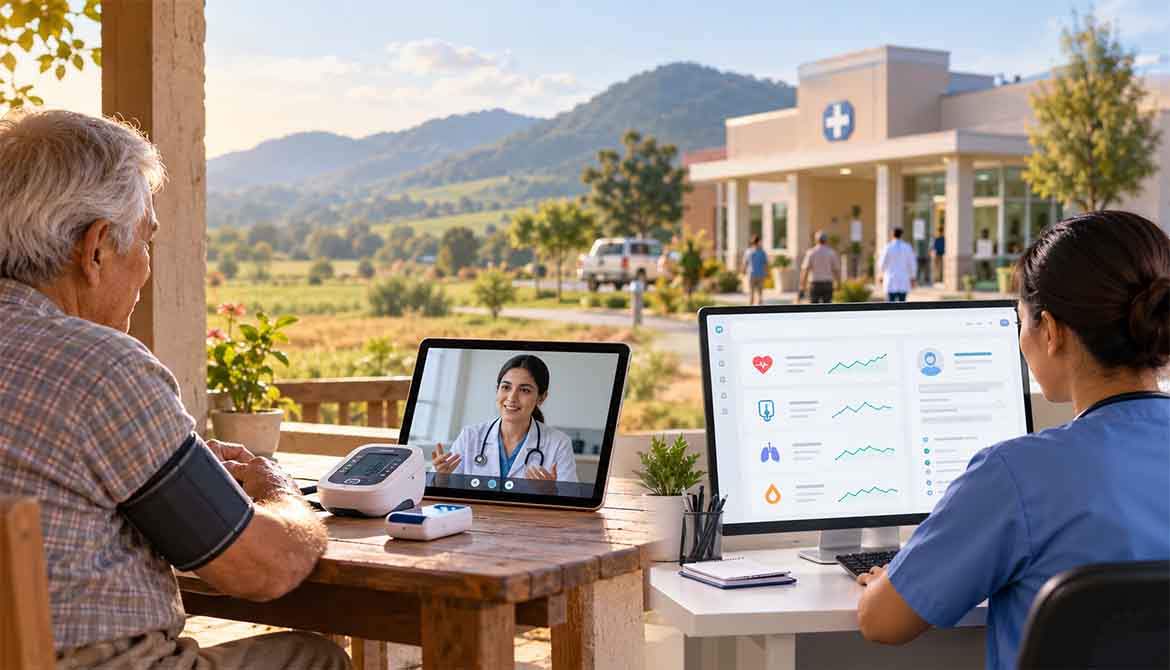


Winning RHTP funding and running a care program are two very different jobs. States have received their Rural Health Transformation Program awards, and the organizations named in those plans are now expected to turn plan language into patients enrolled, devices in homes, and measurable results. For many hospitals, FQHCs, and RHCs, remote patient monitoring (RPM) and chronic care management (CCM) are among the most practical ways to do that.
This post is about the second job: what it takes to move from an award to a working program, and how to build one that doesn’t disappear when grant dollars do.
If you’re an independent or DPC practice, RHTP works differently for you. Start with our guide to what RHTP means for independent practices.
Why RPM and CCM Show Up in RHTP Plans
RHTP was built around a handful of goals: improving rural access, strengthening chronic disease management, adopting technology, and making rural providers financially sustainable. RPM and CCM sit at the intersection of all four. Remote monitoring extends care to patients who live far from a clinic or lack reliable transportation. Care management gives clinical staff a structured way to follow patients between visits. Together, they put technology to work on chronic conditions like hypertension, diabetes, COPD, and heart failure, which are more prevalent in many rural communities.
Remote monitoring and health technology are named as qualifying priorities in many approved state plans, and several states have publicly described investments in RPM equipment and patient-facing tools. What your organization can actually do with RHTP dollars, though, depends on your state’s approved plan and on the terms of the specific award, subaward, or contract you hold. Start there, not with a vendor demo.
Start With What Your Award Actually Allows
Before designing anything, read the funding documents closely. Three questions shape everything that follows:
What is the money allowed to buy?
Some awards cover devices and software. Others cover staffing, workforce training, or health IT infrastructure. A few may restrict spending to specific populations or service lines. A program designed around the wrong cost category will stall at the first budget review.
What does the state expect you to report?
States are accountable to CMS for how RHTP funds are used, and that accountability typically flows down to recipients as reporting requirements. If your agreement names outcome measures, such as blood pressure control, readmissions, or emergency department use, build your program so those numbers are captured from day one rather than reconstructed later. Confirm the exact requirements with your state program office.
How long does the money last?
RHTP runs through fiscal year 2030, but individual awards, subawards, and contracts may be shorter. Know your end date, because it determines how aggressively you can invest in startup costs versus ongoing operations.
Build the Program Around Workflow, Not Devices
The most common reason RPM programs underperform is not the hardware. It is the workflow around it. Devices get shipped, patients get enrolled, and then no one is clearly responsible for reviewing the readings, calling the patient who has gone quiet, or documenting the time that billing depends on.
For a hospital or health center, a workable program usually needs a few things settled before the first patient enrolls:
- A clinical owner. One practitioner or care team lead accountable for the program, with defined escalation paths when readings fall outside range.
- A patient selection approach. Start with a defined cohort, such as patients with uncontrolled hypertension or diabetes who have recent visits, rather than trying to enroll everyone at once. Patient selection and clinical appropriateness are determined by the treating practitioner.
- Clear staffing. Decide who reviews data, who handles outreach, and who documents time. In rural settings with thin staffing, this often means pairing a small internal team with a clinical monitoring partner.
- Patient support. Rural patients may face limited broadband, low digital comfort, or both. Cellular-connected devices and phone-based outreach can help reduce dropout. Our guide to the RPM implementation workflow walks through the operational steps in more detail.
Equally important is where the data lives. A monitoring program that runs in a separate portal creates double documentation and gets abandoned. Technology that connects to your existing EHR keeps readings, care plans, and billing documentation in one place, which is why integrated EHR and RPM matters more than any single device specification.
Plan for the Day the Grant Ends
This is the part many RHTP plans underweight, and it is the part that decides whether your program survives.
Grant funding is well suited to startup costs: devices, platform setup, training, and early staffing. It is a poor foundation for ongoing operations, because it ends. The organizations that build durable programs treat RHTP dollars as the bridge and Medicare reimbursement as the destination.
Medicare pays separately for qualifying care management and remote monitoring services, which means a well-run program can generate revenue that supports itself. For RHCs and FQHCs specifically, the billing rules have changed recently and deserve attention. CMS retired the bundled general care management code (G0511) that these organizations used for years, and they now report individual care management and monitoring codes, such as the RPM and CCM CPT codes, instead. Because reimbursement for RHCs and FQHCs follows different payment rules than a standard physician practice, confirm current requirements with your Medicare Administrative Contractor and CMS guidance before building a revenue model around any assumption. Our overview of RPM CPT codes explains how the underlying codes work; note that it is written for physician practices, so RHC and FQHC billing details should be verified separately.
The practical takeaway: model your program with and without grant support. If it only works with grant dollars, redesign it before you launch, not after the funding runs out.
Choose Technology You Can Keep Using
Because the program has to outlast the grant, vendor selection deserves more scrutiny than it usually gets. A few questions worth asking any RPM or CCM technology partner:
- Does the platform integrate with our current EHR, or does it require staff to work in a second system?
- Who provides clinical monitoring support if our staff cannot cover every alert?
- How does the platform track the time and activity that billing documentation requires?
- What happens to our data, devices, and workflows if RHTP funding ends or we change vendors?
- Can the vendor support the reporting our state agreement requires?
Advaa Health’s technology is designed to connect with the EHR your organization already uses, supporting RPM, CCM, BHI, TCM, PCM, and RTM workflows without forcing a system switch. If you’re evaluating partners for an RHTP-funded initiative, our rural healthcare transformation page outlines how we support hospitals, FQHCs, and RHCs, and our remote patient monitoring and chronic care management pages cover the services in detail.
A Realistic First 90 Days
Organizations that move well tend to follow a simple arc rather than a big-bang launch. In the first month, confirm what the award allows, name the clinical owner, and select the initial patient cohort. In the second month, finalize the technology and workflow, train the team, and run a small pilot with a handful of patients to find problems while they are cheap to fix. In the third month, expand enrollment, start capturing the outcome and utilization data your state expects, and check that documentation supports the billing model you plan to rely on.
None of this requires a large team. It requires clear ownership, a narrow start, and a program designed to pay for itself.
The Bottom Line
RHTP funding gives rural hospitals, FQHCs, and RHCs a rare chance to invest in chronic care technology. The organizations that benefit most will be the ones that treat the grant as a starting point: match the program to what the award allows, build workflow before scale, and design for Medicare reimbursement from the beginning so the work continues after the funding ends.
This article is for general informational purposes and is not legal, billing, or compliance advice. RHTP eligibility, permitted uses, and reporting requirements vary by state and by award. Medicare reimbursement depends on provider type, patient eligibility, documentation, and current CMS and MAC rules. Consult your compliance officer, legal counsel, or MAC for guidance specific to your organization.
Talk to Advaa Health about supporting your RHTP-funded RPM and CCM program →